Metaphor identification & analysis for corpus languages
Read the metaphors a culture thought in.
The Romans did not merely compare anger to fire — they understood anger figuratively, in terms of fire. Figuraliter recovers those conceptual metaphors at the scale of a whole canon, rendering each concept as a constellation of source domains, every mapping grounded in the passages that attest it.
How do you identify conceptual metaphors in a language with no living speakers, without simply relying on scholarly intuition? Metaphor must be inferred from patterns of usage across thousands of passages and highly variable domain vocabularies — analysis that delivers real anthropological insight but does not scale by hand, even for a corpus the size of classical Latin.
Conceptual metaphors are not isolated ornaments but systematic mappings of conceptual structure that constitute understanding. Figuraliter recovers them from the textual record accurately and systematically, across a text corpus of your choosing.
You name a concept in English — anger, love, courage, death — and Figuraliter discovers the words and expressions, literal and figurative, that a language uses to capture it. Those become the basis of the analysis: it returns the constellation of source domains that structure the concept across the surviving canon (or any collection of texts you specify), ranked by evidence weight. Open any domain and it reveals the mapping structure beneath: the specific submappings, ordered from central to peripheral, each opening onto the passages that attest it. Every metaphor the tool names is one an author actually wrote.
i.
Choose a corpus, or bring your own
Analyse a standard scholarly corpus or upload your own text collection. Whatever you choose becomes the evidential base for the analysis — so every metaphor identified is precise and empirically grounded in real, citable passages, never asserted in the abstract.
ii.
Mapping structure, made explicit
The unit of analysis is the (sub)mapping. Figuraliter reconstructs which concrete source domains structure a target concept, the specific mappings each licenses and their entailments, and how they nest — the more specific grouped under the more central — so the result is a conceptual system, not a word list.
iii.
Search beyond surface form
An advanced semantic search engine underpins the system, abstracting away from surface morphological form to identify metaphorical expressions wherever they occur across a large corpus — a decisive time-saver for metaphor research, and indispensable for richly inflected languages where one phrase wears many shapes.
iv.
Built for Latin, not bound to it
Latin is the proving ground, but the apparatus is corpus-agnostic. English is already a first-class citizen, and support for ancient Greek is coming — bringing the same systematic metaphor analysis to further corpus languages.
02
The metaphor constellation
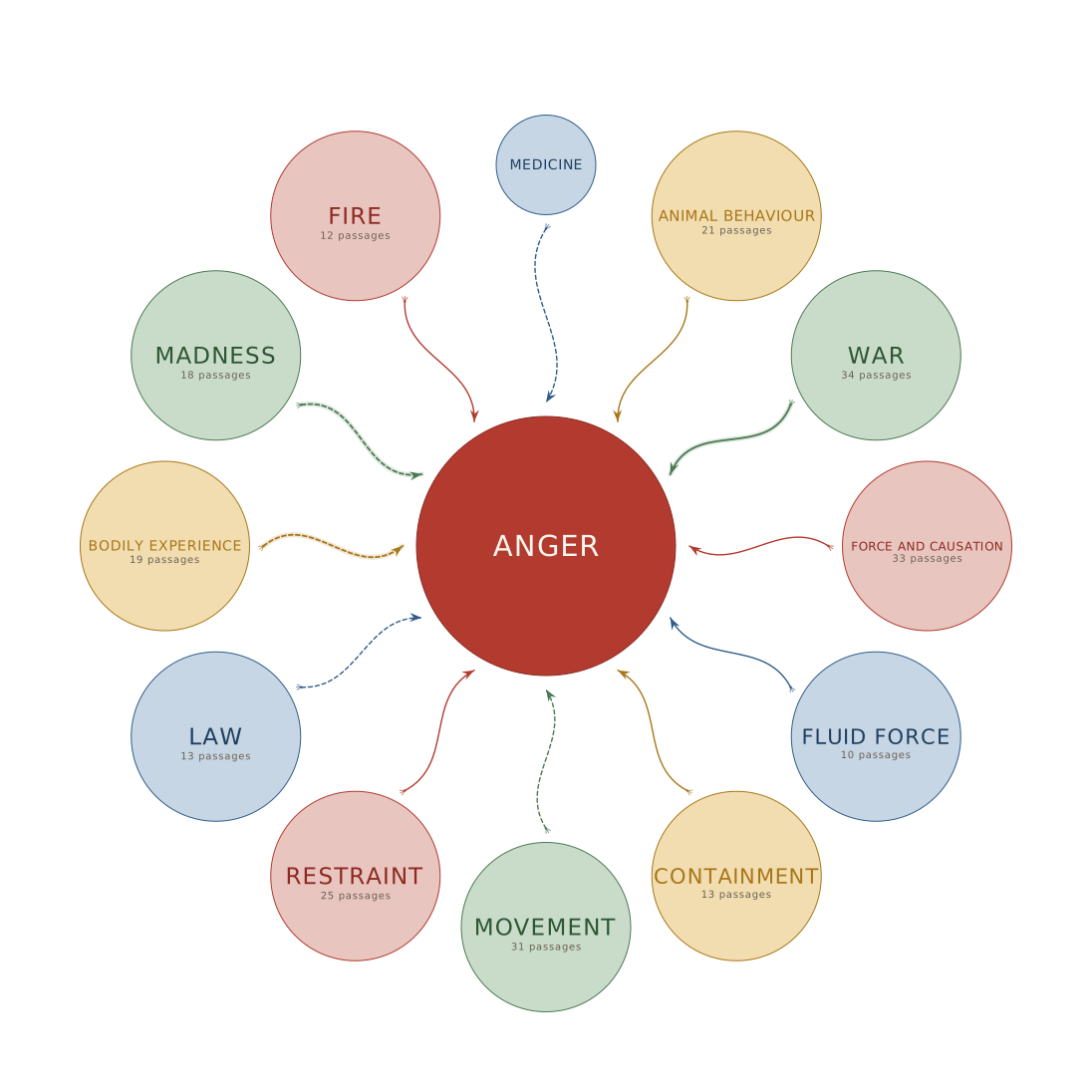
Each source domain is a node, ranked by evidence weight and connected to the concept at the centre. Below is an analysis of anger — ira — in the corpus of Seneca the Younger's writings: anger understood as war, as a force, as fire, as a wild animal's behaviour, as madness, as something to be restrained.
Anger — ira — as metaphorised in the writings of Seneca the Younger
The default reading. Place a target concept — ira, above — at the centre and ask: by which source domains did the Romans understand it? The orbit fills with the sources, weighted by how strongly the corpus attests each.
Scope of source
The inverse reading
The same engine, run the other way. Place a source domain — ignis, fire — at the centre, and the orbit fills with the targets it figures: not only anger but love, sedition, and eloquence. Together the two modes give two perspectives on Latin speakers' conceptual system.
03
Every mapping rests on passages
All the textual evidence is displayed, grouped under the submappings that constitute the conceptual metaphor. Passages can be re-sorted by author, work, period, genre, lexeme, or confidence. Each carries the Latin with its trigger lexemes marked, a translation, a full citation, the metaphoricity judgement, and the confidence the reading was assigned. Completed analyses can be exported as Markdown, PDF, or DOCX.
The intensity, onset, and physiological character of the emotion — how anger builds, blazes, and consumes from within the body.
PrivilegedConventionalizedStructural
Domain rank
#7 of 42 source domains in this analysis
Attesting author
1 — Seneca, Lucius Annaeus
Attestation period
Early Imperial
Sub-mappings defined
42 entailments in Stage 3
Fixed-expression hits
2 of 34 passages via multi-word CMEs
Entrenched lexemes
flagrare, ardere, exardescere, excandescere
Mappings
Source domainTarget domain
FIREANGER
FIRE BURNING INWARD FROM THE CHESTTHE PHYSIOLOGICAL HEAT OF ANGER (2)
FIRE CATCHING AND FLARINGTHE RAPID ONSET OF ANGER (2)
SMALL SPARKS PRODUCING LARGE FLAMESTRIVIAL PROVOCATIONS (1)
FULL CONFLAGRATIONTHE PEAK OF ANGER (1)
THE VISIBLE SIGNS OF BURNINGTHE VISIBLE SIGNS OF ANGER (1)
HEATINTENSITY OF EMOTION Inherited
Evidence · 12 passages
THE PHYSIOLOGICAL HEAT OF ANGER IS FIRE BURNING INWARD4 · 33%
THE RAPID ONSET OF ANGER IS FIRE CATCHING3 · 25%
THE VISIBLE SIGNS OF ANGER ARE THE SIGNS OF BURNING2 · 17%
TRIVIAL PROVOCATIONS ARE SPARKS PRODUCING LARGE FLAMES1 · 8%
THE PEAK OF ANGER IS FULL CONFLAGRATION1 · 8%
Sort by
Submapping
1°
Author
Work
Period
Genre
Lexeme
Confidence
THE PHYSIOLOGICAL HEAT OF ANGER IS FIRE BURNING INWARD FROM THE CHEST
2 passages
Seneca,De Ira1.1.4
Philosophy · drama · Early Imp. · 4–65 CE
◆ 0.95CME
flagrant ac micant oculi, multus ore toto rubor exaestuante ab imis praecordiis sanguine, labra quatiuntur, dentes comprimuntur, horrent ac surriguntur capilli, spiritus coactus ac stridens…
The eyes blaze and glitter, the face all reddens with the blood boiling up from the depths of the chest; the lips tremble, the teeth are clenched, the hair stands on end and rises stiff, the breath is compressed and hissing.
Analytic note
Seneca's opening cluster stacks flagrant, exaestuante, and the imagery of blood surging up from the chest — anger read as literal fire burning inward, the body a furnace. Highest-density fire-imagery site in the corpus.
Seneca,De Ira2.19.3
Philosophy · drama · Early Imp. · 4–65 CE
◆ 0.93CME
Volunt itaque quidam ex nostris iram in pectore moveri effervescente circa cor sanguine; causa cur hic potissimum adsignetur irae locus non alia est, quam quod in toto corpore calidissimum pectus est.
Some of our school hold that anger is set in motion in the breast by the blood boiling up around the heart; the reason this above all is assigned as the seat of anger is simply that in the whole body the breast is the hottest part.
THE RAPID ONSET OF ANGER IS FIRE CATCHING AND FLARING
2 passages
Seneca,De Ira2.6.4
Philosophy · drama · Early Imp. · 4–65 CE
◆ 0.95CME
Modus enim esse non potest, si pro facto cuiusque irascendum est; nam aut iniquus erit, si aequaliter irascetur delictis inaequalibus, aut iracundissimus, si totiens excanduerit quotiens iram scelera meruerint.
There can be no measure of anger if we must be angry in proportion to each act done; for one will be unjust if he is equally angry at unequal offences, or utterly enraged if he catches fire as often as crimes deserve anger.
TRIVIAL PROVOCATIONS ARE SMALL SPARKS PRODUCING LARGE FLAMES
1 passage
Seneca,De Ira3.34.1
Philosophy · drama · Early Imp. · 4–65 CE
◆ 0.95CME
Crede mihi, levia sunt propter quae non leviter excandescimus, qualia quae pueros in rixam et iurgium concitant.
Believe me, the things over which we blaze up so violently are trifles — the sort of thing that stirs children to quarrel and squabble.
THE PEAK OF ANGER IS FULL CONFLAGRATION
1 passage
Seneca,De Ira3.1.1
Philosophy · drama · Early Imp. · 4–65 CE
◆ 0.95CME
Id aliquando palam aperteque faciendum est, ubi minor vis mali patitur, aliquando ex occulto, ubi nimium ardet omnique impedimento exasperatur et crescit…
This must sometimes be done openly, when the strength of the evil admits it; at other times covertly, when it blazes too fiercely and is enraged and grows against every obstacle.
04
A research method operationalised
Figuraliter puts into practice a corpus-based Metaphor Identification Procedure for Latin developed by University of Exeter researchers — an extension of the Pragglejaz Group's procedure to a morphologically rich language with no native speakers. What was hours of lexicon work and months of close reading becomes a four-stage pipeline, grounded in theory and built on expert-curated lexical resources.
Stage 1
Semantic field expansion
Beginning from a single concept named in English, a symbolic lexico-conceptual database identifies the target-domain vocabulary, conventionalised metaphorical expressions, and image-schematic expressions that capture it in the language — and generates a morphological query for each.
Stage 2
Enriched corpus search
Lemma queries match every inflected form; construction queries match fixed syntactic patterns regardless of word order or intervening material, across 38 construction types.
Stage 3
Metaphor analysis
Each retrieved passage is read for its source domain and mapping label, its trigger lexemes, and a confidence — comparing the basic and contextual senses in the spirit of the identification procedure.
Stage 4
Aggregation & scoring
Source domains are scored by evidence weight, clustered into hierarchies with specific mappings grouped under their primary mapping, and rendered as the interactive constellation.
05
Tested against ground truth
The procedure is not a black box. Its output is evaluated against a hand-curated dataset of 72 expert-annotated metaphor mappings drawn from published scholarship — including studies of IDEAS ARE LOCATIONS, COMMUNICATION IS FOOD, Latin's metaphors of courage and spatial metaphors of time.
Domain recall
What proportion of the expert-identified source domains does Figuraliter recover?
Mapping precision
When Figuraliter identifies a mapping, how often does it match the expert labelling?
Salience ordering
Does the system's evidence weighting correlate with experts' salience rankings?
Coverage by genre
Does performance vary by author, period, or genre — and where are the gaps?
The researcher controls the method
The methodological design and the precise querying operations are conceived and implemented by the researcher; the validation metrics and ground-truth data are derived from published scholarship. The distribution of metaphors and the passages that support them are always laid open for the scholar to study and interpret.
An anthropological tool
Metaphors are treated, in the tradition of an anthropology of antiquity, as cultural facts — shared structures of thought, not the idiosyncrasies of individual authors. The discovery is often that mappings one culture takes for granted are not universal, and that a corpus language preserves a world organised in unfamiliar ways.
Request access
Register your interest and we will be in touch as accounts open and new corpora and languages come online.
Figuraliter is research software in active development at the University of Exeter. Leave your details and we will be in touch as accounts open — and as new corpora and languages (English now, ancient Greek soon) come online.
New accounts require admin approval before sign-in. If you have an invite link, paste the token below the registration form.